


Law & Politics
Books
See also Chapters & Articles below
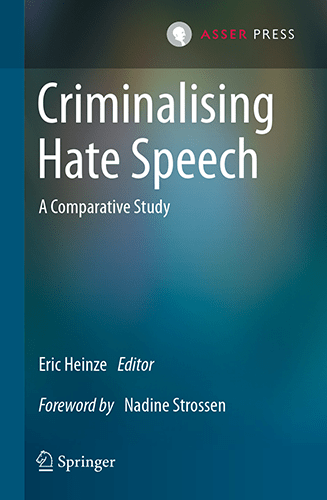
CRIMINALISING HATE SPEECH
A Comparative Study
Asser Press 2025
— Buy it on Amazon —
This is the world’s first book to gather detailed, country-by-country studies devoted entirely to the problem of hate speech, spanning more than twenty nations. The abundance of case studies will help to dramatize the controversies that have been sparked by hateful expression in ways that continue to be relevant far beyond the borders of any one nation.
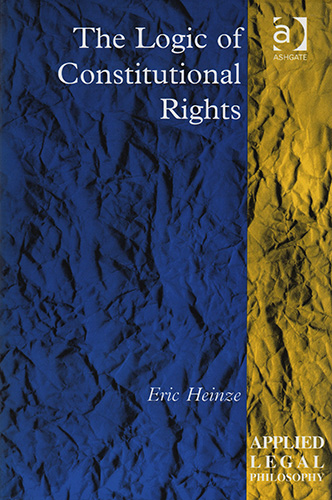
THE LOGIC OF CONSTITUTIONAL RIGHTS
Ashgate 2005; Routledge re-issue hardback & paperback 2017
– Buy it on Amazon –
Examines linguistic and conceptual limits to empirical arguments through the example of constitutional rights ● Chinese translation as part of the series Western Classics of Legal Logic, University of China Political Science & Law Press, translated by Wang Jianfang (2026), including new Introduction by author in English and Chinese ● Review: Georg Vanberg, Law Courts, vol. 16(1) (2006), pp. 1-3
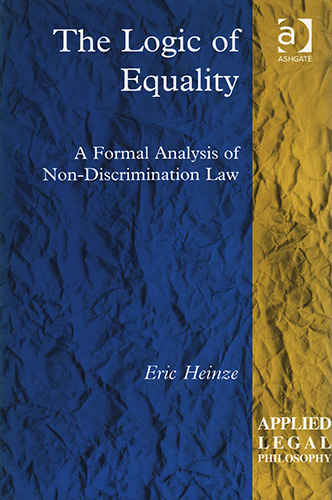
THE LOGIC OF EQUALITY
Ashgate 2003; Routledge re-issue hardback 2017, paperback 2019
– Buy it on Amazon –
Examines linguistic and conceptual limits to empirical arguments through the example of non-discrimination law ● New introductory essay entitled Equality and Dialectic in Law in Chinese translation as part of the series Western Classics of Legal Logic, University of China Political Science & Law Press, translated by Xu Mengxing (2017) ● Review: Amelia Simpson, Federal Law Review, vol. 33 (2005), pp. 177-79 ● Review: Douglas Grob, Law Courts, vol. 15(10) (2005), pp. 911-16
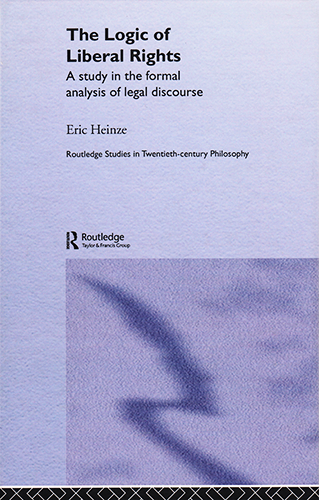
THE LOGIC OF LIBERAL RIGHTS
Routledge 2003, hardback & ebook
– Buy it on Amazon –
Examines linguistic and conceptual limits to empirical arguments through the example of ECHR, British, Dutch, German and French human rights jurisprudence ● Chinese translation as part of the series Western Classics of Legal Logic, University of China Political Science & Law Press, translated by Yu Shiyang (2019) including new Introduction by author in English and Chinese.
OF INNOCENCE AND AUTONOMY:
Children, Sex and Human Rights
Ashgate 2000; Routledge re-issue hardback 2017, paperback 2019
– Buy it on Amazon –
Groundbreaking collection of essays synthesising psychological, sociological, and critical-legal approaches to controversies about children’s sexuality ● Review: Jean Scandlyn, Human Rights and Human Welfare, vol. 6 (2006), pp. 75-87
Chapters and articles
‘Banning Hate Speech: Are the Debates about Liberal Values or about Democratic Values?’, Oxford Journal of Legal Studies (forthcoming 2025)
‘Free Speech as a Prerequisite for All Other Rights’, Alan Chen and Ashotosh Bhagwat, eds., The Elgar Companion to Freedom of Speech and Expression (forthcoming, Edward Elgar, 2025)
‘How we should – and shouldn’t – ban extremist speech’, in Robin Simcox, ed., Countering extremism: defending free speech, UK Government: UK Commission for Countering Extremism (2025).
Commentary on Frank Dietrich, ‘AI-based removal of hate speech from digital social networks—chances and risks for freedom of expression’, AI and Ethics (2024). First view: https://doi.org/10.1007/s43681-024-00646-9
‘Identitarian Hatreds and Disloyalty Propaganda: Revisiting the Eurocentrism of Human Rights’, Human Rights Quarterly, 46: 4, pp. 616-638.
‘Between Ultra-Zionism and antisemitism: Brazil as a Mirror of the World’, with Renan Antônio da Silva, K. la Revue, 19 September 2024 (version française : ‘Entre ultra-sionisme et antisémitisme : Le Brésil, miroir du monde’, 25 septembre 2024)
‘When do – and don’t – Democracies require Transparency?’, Interview with Prof. Fabrizio Sciacca, Heliopolis, 14 August 2024 vol. 22: 1
‘A Tool to Advance Imperial Interests: Leftist Self-Scrutiny and Israeli Wrongdoing’, Responses to 7 October: Law & Society, Rosa Freedman and David Hirsh, eds. (London: Routledge, 2024)
‘But Israel claims to be a democracy! – Hypocrisy, double standards, and false equivalences’, Responses to 7 October: Universities, Rosa Freedman and David Hirsh, eds. (London: Routledge, 2024)
‘Critical Theory and Memory Politics: Leftist Autocritique After the Ukraine War’, International Journal of Law in Context vol. 20:2 (2024), 184–203
‘Global Libertarianism: How Much Public Morality Does International Human Rights Law Allow?’ International Theory (2022), 14 (3), pp. 571–594 (arguing that public morals cannot suffice as grounds for limiting human rights)
‘The Myth of Flexible Universality: Human Rights and the Limits of Comparative Naturalism’, 39:3 Oxford Journal of Legal Studies (2019), pp. 624–653 (acknowledging foundations for human rights in ancient belief systems but challenging the view that they enhance the case for universality).
‘An Anti-Liberal Defense of Free Speech: Foundations of Democracy in the Western Philosophical Canon’, Oxford Handbook of Law and Humanities (S. Stern et al. eds.) Oxford University Press (2019) (examining foundations for free speech in Western philosophical tradition) (Dutch version: ‘Een antiliberale verdediging van de vrijheid van meningsuiting: grondslagen van de democratie in de westerse filosofische canon’, in De grenzen van het publieke debat – Over verdraagzaamheid en de vrijheid van meningsuiting in de democratische samenleving (Tom Herrenberg, ed.), Boom Juridische Uitgevers, pp. 111-40).
‘No-platforming and safe spaces: Should universities censor more (or less) speech than the law requires?’ Croatian Political Science Review, Vol. 55, No. 4, 2018, pp. 79-108
‘Theorising Law and Historical Memory: Denialism and the Pre-Conditions of Human Rights’, 13:1 Journal of Comparative Law (2018), pp. 43-60, reprinted in (4) Diritto Penale Contemporaneo (2019), pp. 175-91 (examining states’ uses of law to avoid scrutiny of human rights abuses)
‘Democracy, Ontology, and the Limits of Deconstruction’, in Hate, Politics and Law: Critical Perspectives on Combating Hate (T. Brudholm & B. Johanssen, eds., Oxford University Press, 2018), pp. 94-112 (examining necessary limits to post-structuralist critiques of democratic legal theories)
‘What is the Opposite of Injustice?’, 30:3 Ratio Juris (2017), pp. 353–371 (critiquing the formal-logical, mutual exclusion between the concepts of ‘justice’ and ‘injustice’)
‘Towards a General Theory of Law and Historical Discourse’, in Law and Memory: Towards Legal Governance of History (U. Belavusau & A. Gliszczyńska-Grabias, eds., Cambridge University Press, 2017), pp. 413-33 (proposing theory of governments’ uses of legal means to promote public understandings of historical events)
‘The Constitution of the Constitution: Democratic Legitimacy and Public Discourse’, in Rancière and Law (J. Extabe & M. Lopez, eds., Routledge, 2017), pp. 111-28 (examining Jacques Rancière’s notion of radical, popular democracy to argue that public discourse remains distinctly constitutive of legal legitimacy)
‘Taking legitimacy seriously: A return to deontology’ (invited article responding to debate between Jeremy Waldron and James Weinstein, also including Robert Post, Vincent Blasi, Frederick Schauer, and Steven Shiffrin), 32:3 Constitutional Commentary (2017), pp. 631-50 (drawing upon socio-linguistic theory to challenge Waldron’s view of democratic legitimacy)
‘Hate speech and the normative foundations of regulation’, review essay: Jeremy Waldron, The Harm in Hate Speech (Harvard University Press, 2012) and M Herz & P Molnar, eds., The Content and Context of Hate Speech (Cambridge University Press, 2012), in 9(4) International Journal of Law in Context (2013), pp 590-617 (challenging conventional, liberal assumptions invoked both to oppose and to support limitations on expression)
‘The Reality and Hyper-reality of Human Rights: Public Consciousness and the Mass Media’, in Examining Critical Perspectives on Human Rights: The End of an Era?, R. Dickenson et al., eds., Cambridge University Press (2012), pp 193-216 (arguing that not only bias and distortions, but even the media at their best inevitably create serious problems surrounding public understandings of human rights)
‘Public Awareness of Human Rights’, 14 International Journal of Human Rights 2010, pp. 491 – 523 (co-authored with R Freedman) (critically examining patterns of mass reporting of human rights)
‘Wild-West Cowboys versus Cheese-Eating Surrender Monkeys: Some Problems in Comparative Approaches to Extreme Speech, in Extreme Speech and Democracy chapter 10, James Weinstein and Ivan Hare, eds., Oxford University Press, 2009, pp. 182 – 203 (warning against unjustifiable comparisons across legal systems in view of divergent historical and cultural contexts)
‘Cumulative Jurisprudence and Hate Speech: Sexual Orientation and Analogies to Disability, Age and Obesity’, 12 International Journal of Human Rights (2009), pp. 193 – 209 (arguing, from the perspective of a scholar favourable to rights of individual sexuality, against the inclusion of sexual minorities within the purview of hate speech bans) ● Reprinted in Extreme Speech and Democracy chapter 14, James Weinstein and Ivan Hare, eds., Oxford University Press, pp. 264 – 84 (2009) ● Reprinted in Protection of Sexual Minorities since Stonewall—Progress and Stalemate in Developed and Developing Countries, Phil C. W. Chan, London: Routledge, (2010), pp. 62 – 78.
‘The Meta-ethics of Law: Book One of Aristotle’s Nicomachean Ethics’, 6(1) International Journal of Law in Context (2009), pp. 23 – 44 (examining Aristotle’s assumption of the ethical content of law grounded in culture)
‘Even-handedness and the Politics of Human Rights’, 21 Harvard Human Rights Journal (2008), pp. 7 – 46 (proposing general theory as to what does and does not count as legitimately ‘politicising’ human rights)
‘Truth and Myth in Critical Race Theory and LatCrit: Human Rights and the Ethnocentrism of Anti-Ethnocentrism’, 20 National Black Law Journal (Columbia University edition) (2008), pp. 107 – 62 (examining paradoxes within legal-realist and critical-legal jurisprudence) ● Reprinted in Rights in Context Law and Justice in Late Modern Society ch. 6 (R Banakar, ed., Autumn 2010).
‘Towards the Abolition of Hate Speech Bans’, in Religious Pluralism and Human Rights, Titia Loenen & Jenny Goldschmidt, eds., Intersentia (2007), pp. 295 – 309 (examining bans on anti-religious hate speech)
‘Epinomia: Plato and the First Theory of Law’, 20:1 Ratio Juris (2007), pp. 97 – 135 (examining Plato’s critique of market-driven legal regimes)
‘The Status of Classical Natural Law: Plato and the Parochialism of Modern Theory’, 20 Canadian Journal of Law and Jurisprudence (2007), pp. 323 – 50 (examining the importance of Greek, as opposed to the more usual post-Roman or Biblical foundations for justice theory) ● Reprinted in Natural Law: A Jurisprudential Debate, P. Sabiha Khanum, ed., Hyderabad, IN: Icfai University Press, 2008, ch. 3.
‘Viewpoint Absolutism and Hate Speech’, 69 Modern Law Review (2006), pp. 543 – 82 (examining tensions between philosophical, empirical, and doctrinal claims about free expression)
‘Children’s Rights’, in Governments of the world: a global guide to citizens’ rights and responsibilities (ed. Chester Neal Tate), New York: Macmillan (2006), pp. 172-76.
‘The Logic of Standards of Review in Constitutional Cases’, 28 Vermont Law Review (2003), pp. 121 – 47 (arguing that the necessary conceptual indeterminacy within concepts justifying judicial review can emerge only within wholly determinate conceptual assumptions)
‘Sexual Orientation and International Law: A Study in the Manufacture of Cross-Cultural “Sensitivity”‘, 22 Michigan Journal of International Law (2001), pp. 283 – 309 (arguing, contrary to global trends seeming to favour gay rights, that such developments have induced hostile states to crack down far more brutally) ● Reprinted in Discrimination and Toleration, Kirstin Hastrup, ed. (Nijhoff, 2002), pp. 205 – 27.
‘The Universal Child?’ in Of Innocence and Autonomy: Children, Sex and Human Rights, Eric Heinze, ed., Ashgate (2000), pp. 3-24 (examining the extent and limits of children’s autonomy over their sexual activity)
‘The Construction and Contingency of the Minority Concept,’ in Minority and Group Rights Toward the New Millennium, Bill Bowring & Deirdre Fottrell, eds., Kluwer (1999), pp. 25 – 74 (examining conceptual limitations of the minority concept within human rights law)
‘Principles for a Meta-Discourse of Liberal Rights: The Example of the European Convention on Human Rights,’ 9 Indiana International & Comparative Law Review (1999), pp. 319 – 94 (arguing that the necessary conceptual indeterminacy within the jurisprudence of the European Court of Human Rights can emerge only within wholly determinate conceptual assumptions)
‘Discourses of Sexuality: Classical, Modernist and Post-Modernist’, 67 Nordic Journal of International Law (1998), pp. 37 – 76 (contrasting classical liberal, modernist social-scientific, and post-structuralist theories of the legal regulation of sexual conduct)
‘Beyond Parapraxes: Right and Wrong Approaches to the Universality of Human Rights Law,’ 12 Netherlands Quarterly of Human Rights (1994), pp. 369 – 91 (examining the extent and limits of formal concepts of the universality of human rights)
‘Gay and Poor’, 38 Howard Law Review (1994), pp. 433 – 48 (arguing that sexual minorities living at sub-standard income levels require legal services distinct from those designed either particularly for sexual minorities or particularly for poor people)
 Eric Heinze, author